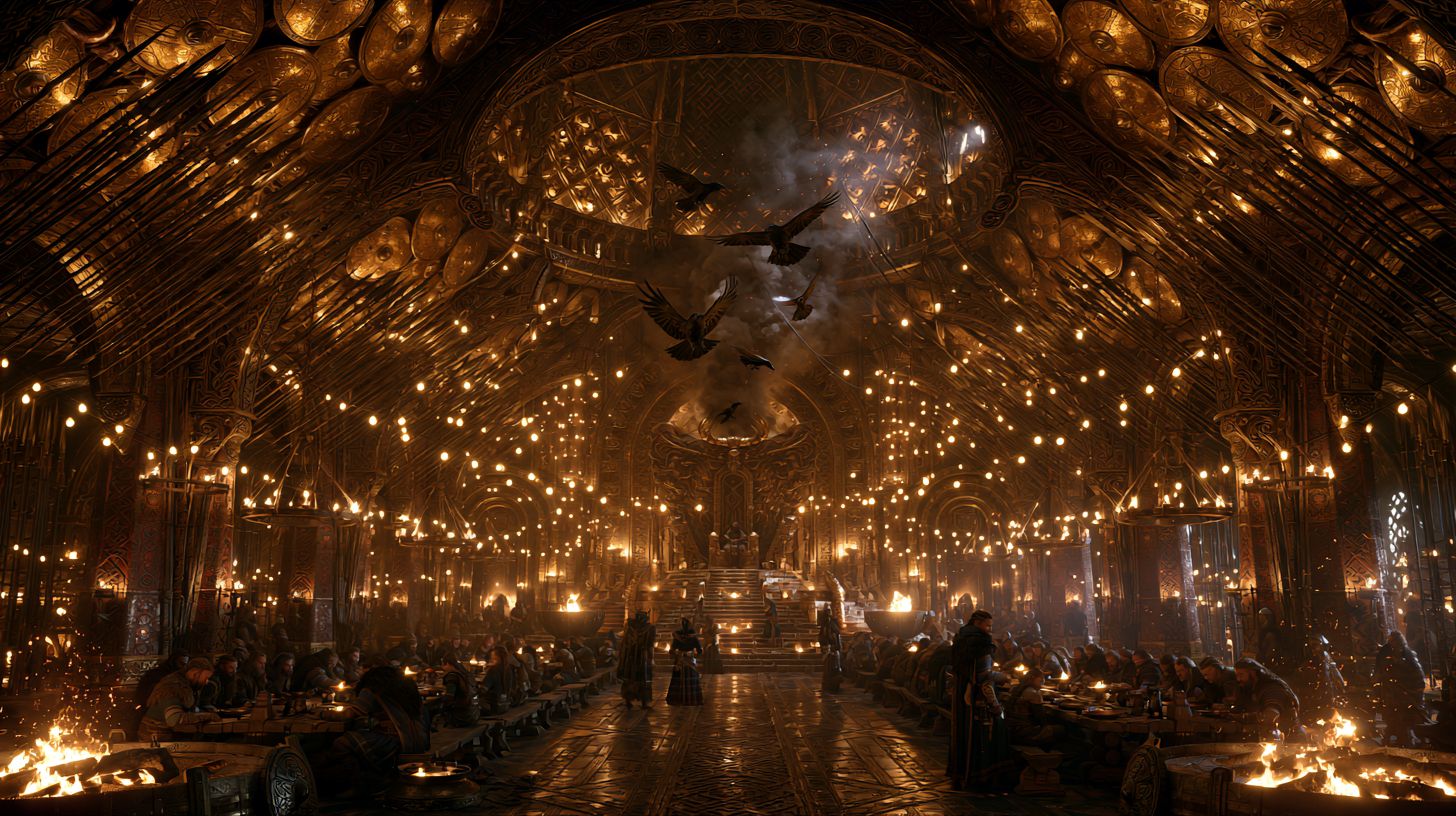
Valhalla
Sit by the fire. The gods, the fair folk, and the old green world are waiting to read for you.
Golden Hall
Who reads for you tonight?
Gods at the high seat, heroes at the bench — each casts your runes in their own voice.
Sail the hidden sea. Tap an isle to see who dwells upon its shore.
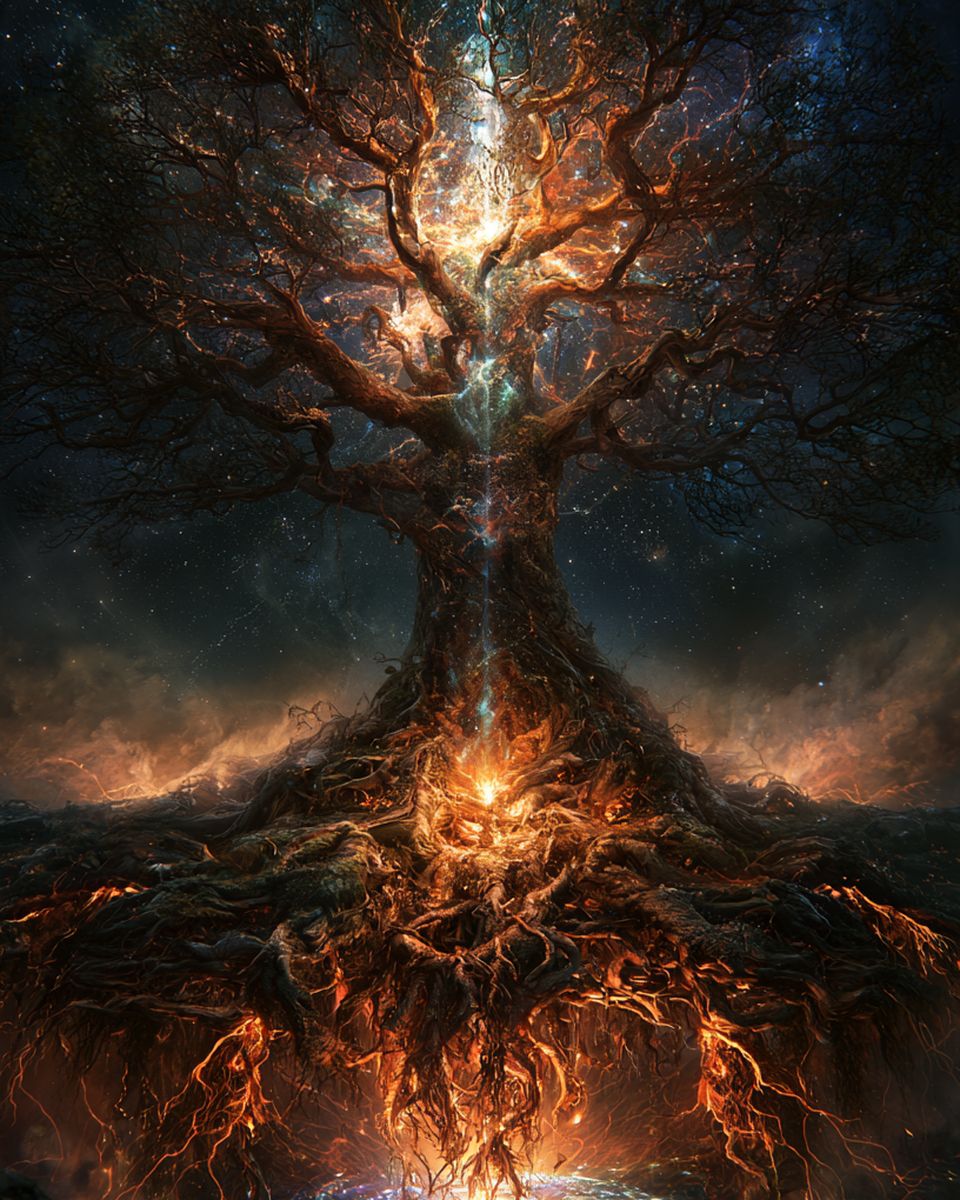
The three roots & the three wells
The tree is not planted in one place. It stands in three, and a well lies under each — which is why the realms are a map and not a ladder.
Under the root that reaches Asgard. Here the three Norns — Urðr what has become, Verðandi what is becoming, Skuld what shall be owed — draw water and white clay and pack it round the trunk each day, or the tree would rot. The gods hold their court here. They do not hold it in Asgard, because judgement is not theirs to keep at home.
Under the root among the frost-giants. Wisdom is in the water and Mímir drinks it daily. Odin asked for one draught and was told the price without softening: he left an eye in the well and drank once. He is the All-Father and he still only got one mouthful, and he still paid first.
Under the root in Niflheim, the coldest place there is. Every river in every world runs out of it, and Níðhöggr lies in it chewing the root from beneath. The tree is being eaten and tended at the same time, always, and that is the actual condition of the world — not a war between the two, but both at once, permanently.
Who lives in the branches
An unnamed eagle sits at the crown with a hawk, Veðrfölnir, perched between its eyes. Four harts — Dáinn, Dvalinn, Duneyrr and Duraþrór — browse the high leaves and never finish. Goats and countless serpents work the lower wood.
And up and down the trunk runs Ratatoskr the squirrel, who carries insults between the eagle at the top and the dragon at the root, and has done so for the whole age of the world. He is not a messenger of the gods. He is a gossip, and he is the only creature on the tree with a job that never changes.
The gods, the fair folk, and the things that walk the mist. Meet them in your readings and voyages to resolve their pages.
The völva read the waters between the worlds. Choose your water, still your mind, and let a vision rise.
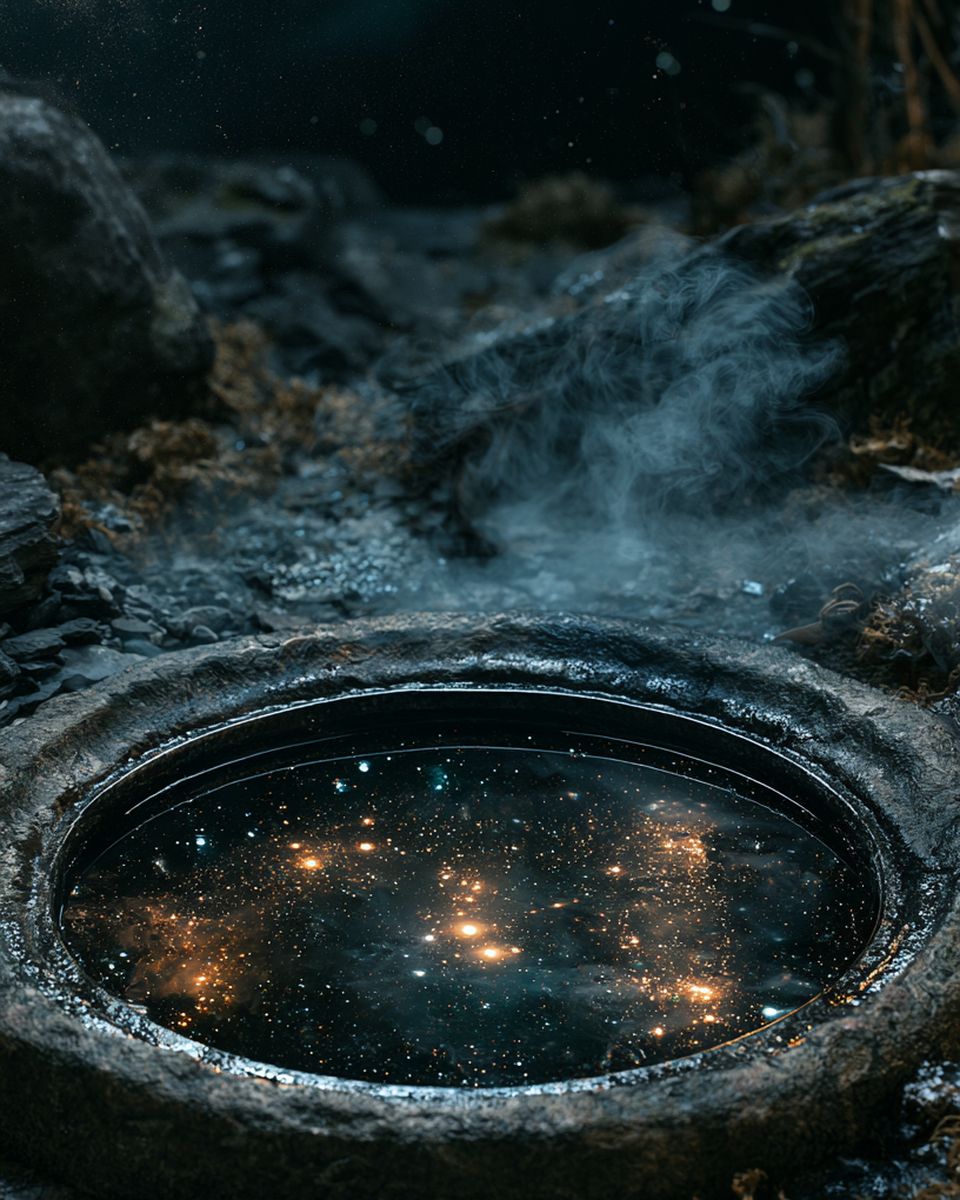
Útiseta · the sitting-out
The old Norse night-vigil: set an intention before you sleep and the sitting-out answers by morning — a vision waiting when you wake. A deeper rite of the seiðr-workers, unlocked with the Hall.
Not a feast — a court. The horn passes three times and what is spoken over it is spoken into the world. The hall is the witness. There is no taking it back.
A heap of stones under open sky. Not a place to ask — a place to settle. Every oath you carried out puts a stone on it, and the heap is the only honest account of you there is.
The first two rounds are honour: to the gods, and to the dead. The third is yours, and it is the dangerous one. A boast is not a wish — it is a debt taken on in front of witnesses. The old hall held a man to what he said over the horn, and held him to it sober.
Speak only what you intend to carry.
This hall does not tell your fortune. It keeps an account. A chooser of the slain is reading it, and she is not sentimental — but she is fair, and she is not finished.
What she counts
Not your worth — she has no instrument for that, and neither does anyone else. She counts what you said you would do, and whether you did it. That is the only thing about a person that can actually be written down.
An unkept oath is recorded as unkept. It is not erased, and it is not held against you forever. The einherjar are not the sinless. They are the ones who kept turning up.
Not a picture of the hall. The hall. Walk your eye round it, and take the relics down off the wall one at a time.
The quick casting, as the war-camps threw it: three staves of the Elder Futhark — what was, what is, what shall be.
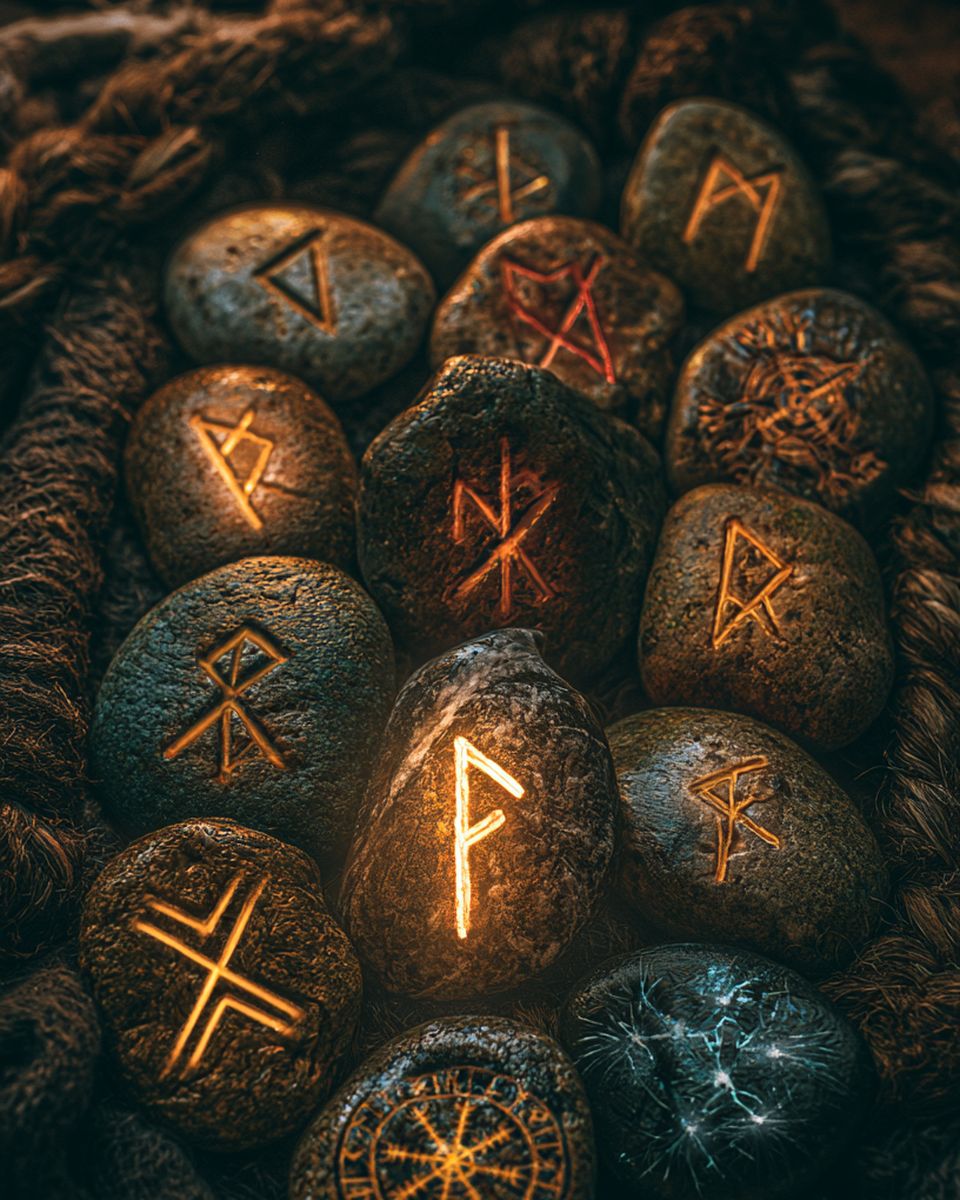
The old rite
Staves cut from a fruit-bearing branch, marked with signs, scattered on a white cloth and read as they fell — so Tacitus described the northern casting in the year 98. The rite in your hands is nineteen centuries old.
The old carved tongue of the North — twenty-four staves, each a letter, a power, and an omen.
Carve your name in runes
Lönnrunor — the secret-rune craft of the carvers, a cipher-hand for what should not be read at a glance.
Read one like this: the ticks on the left count the ætt — the family of eight the rune belongs to. The ticks on the right count its place inside that family. Three families, eight staves each, so every rune is two small numbers and a stick.
They are cut this way at Rök and scratched across the walls of Maeshowe, where a bored Norseman left one that reads, in full: these runes were carved by the man most skilled in runes in the western ocean. He was not being modest, and he was using the easy cipher.
The old weapons are not gone. They are kept. Turn each one with your finger — and hear what it did.